Purpose & Origin
The Large Münsterländer is a German HPR (hunt, point, retrieve) breed with an unusual origin story. In the late 19th century, when German dog clubs began enforcing strict breed standards, the club backing the German Longhaired Pointer insisted on liver or liver-and-white colouring. Black-and-white puppies from those litters were rejected outright.
Breeders around the Münster region refused to discard their black-and-white dogs, continuing to breed them on working merit rather than coat colour. In 1919 they formalised this defiance by founding their own breed club and naming the dogs Münsterländers. The breed is a close relative of the German Longhaired Pointer and shares its full HPR capability: it quarters, points, tracks wounded game, and retrieves from land and water.
Temperament & Behaviour
The Large Münsterländer is cooperative and people-oriented in a way that many HPR breeds are not. It is calm indoors when adequately exercised, good with children, and typically tolerant of other dogs and household animals. Alertness is present without nervousness. The breed bonds closely with its family and does not thrive when left alone for long stretches, which is one reason it has found a following as a companion dog well beyond Germany.
Activity & Training
This is an active sporting dog that needs substantial daily exercise, ideally including off-lead running and mental engagement. Owners without hunting use should substitute fetch, tracking games, or dog sports such as agility or field work. A long walk is not enough on its own.
Training is straightforward. The breed is intelligent and motivated by approval, responding well to positive methods. Recall is generally reliable once established, but the hunting instinct is real and needs to be trained early. It consults and checks in with its handler rather than working independently, which makes it easier to manage afield than more autonomous continental breeds.
Grooming
The coat is long and dense, with feathering on the legs, belly, ears, and tail. This feathering is the main maintenance concern, as it tangles and picks up debris in undergrowth. Brushing two to three times per week is the realistic minimum for a working dog; once a week will result in mats in the ear feathering and behind the legs. Ears should be checked and cleaned regularly, as the drop ear combined with heavy feathering creates conditions for moisture and debris to accumulate. Shedding is moderate and seasonal rather than constant.
Health
The Large Münsterländer is a robust breed with a lifespan of 12 to 14 years. It carries relatively low hereditary disease burden compared with many popular breeds. The main conditions reported are hip dysplasia, elbow dysplasia, hereditary cataracts, and osteochondrosis. Responsible breeders screen for hips, elbows, and eyes before breeding. Health testing remains important when selecting a puppy.
Why these breeds are similar
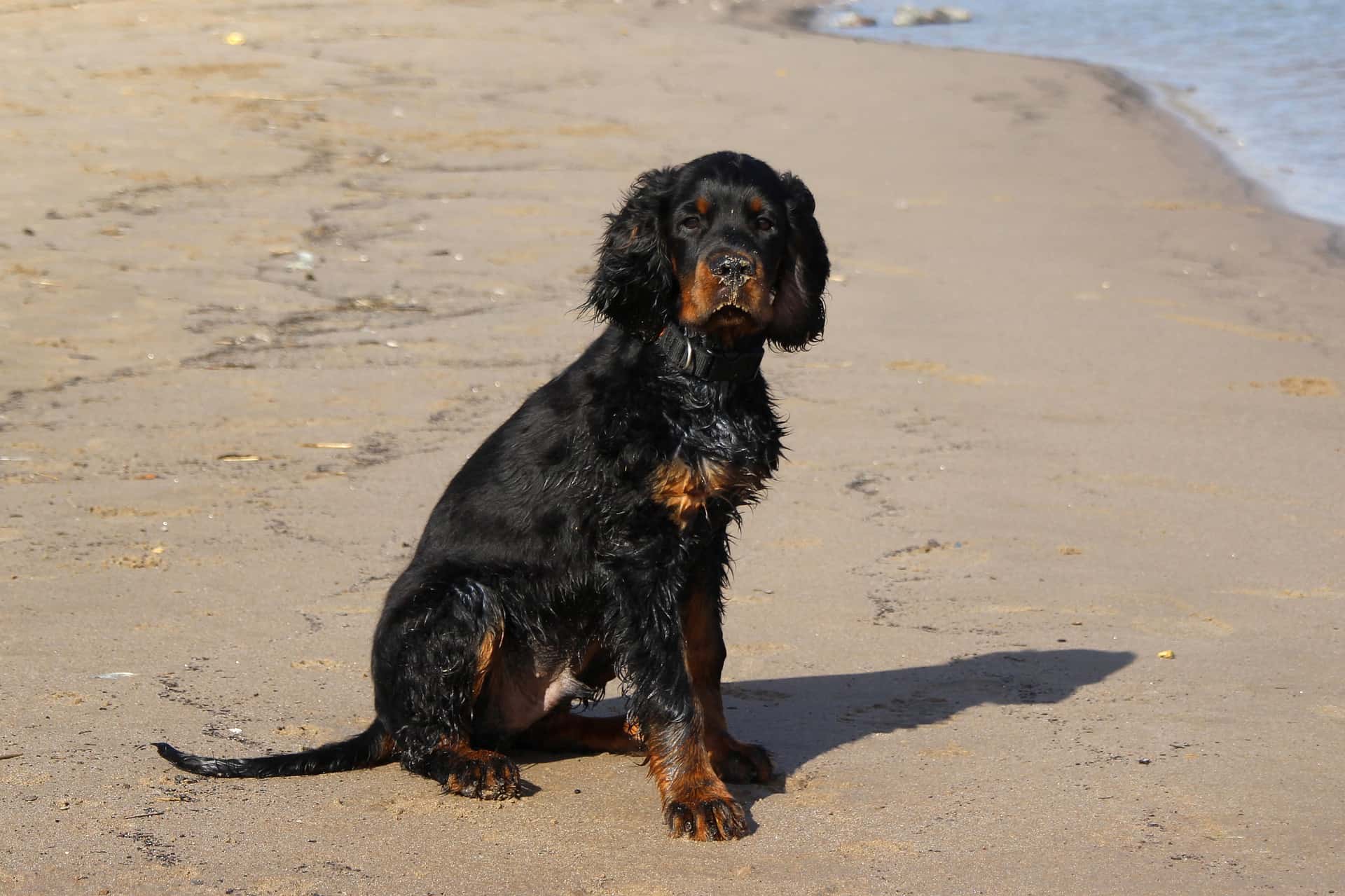
The English Setter, Gordon Setter, Irish Setter, and Irish Red and White Setter all appear in the similar list, and the connection is functional as much as physical. All four are long-coated, feathered gun dogs built to work closely with a handler, cover ground at a sustained pace, and locate game by air scent.
Like the Large Münsterländer they are HPR or pointing breeds with strong field drive paired with an affectionate, family-friendly temperament. The key differences are size and coat pattern: the setters are typically rangier and carry solid or bicolour coats in warm reds and chestnuts, while the Large Münsterländer is a compact black-and-white dog with a denser, less silky coat. Grooming demands and exercise requirements are closely matched across the group.