Purpose & Origin
The Xoloitzcuintli is one of the oldest and rarest breeds on earth, with a history measured not in centuries but in millennia. Clay figures of dogs that clearly resemble the modern Xolo have been found in Mayan, Colima, and Aztec burial sites going back 3,000 years. In Aztec belief, the god Xolotl fashioned the dog from the bone of life and gave it powers of physical and spiritual healing.
The name itself fuses Xolotl with "itzcuintli," the Aztec word for dog. Xolos were kept across Mexico and into Central and South America, valued for warding off spirits and intruders and for their supposed healing warmth. Columbus noted their existence in 1492.
The Spanish Conquest nearly erased the breed, and it survived only in remote regions until a 1953 recovery expedition brought ten dogs back from rural Mexico, leading to formal recognition by Mexico's kennel club in 1956. The AKC registered the breed under the name Mexican Hairless as early as 1887, dropped it from its rolls in 1959 (the only breed ever removed), then reinstated it in 2007 with three size divisions: Standard, Miniature, and Toy.
Temperament & Behaviour
The Xolo is a primitive breed, and that ancestry shows in how it thinks. It is affectionate with its family but approaches that bond on its own terms, devoted without being needy. It is calm and self-possessed rather than frantically energetic, and it reads its environment with genuine intelligence. Strangers get measured reserve rather than open friendliness; the Xolo is an alert, serious watchdog with strong protective instincts, though it is not a nuisance barker. It gets on reasonably well with other dogs and household pets. Some individuals have a talent for escaping enclosures, so a secure yard matters.
Activity & Training
All three sizes need daily exercise, though the Toy can be satisfied with a brisk walk or an indoor session while the Standard needs something longer, a sustained walk or jog. Training is workable but requires patience. The Xolo is not a reflexively obedient dog; it thinks independently, and heavy-handed or boring repetition will get you nowhere. Consistent, positive sessions that keep it mentally engaged produce the best results. It is not an ideal choice for an owner who wants snap compliance.
Grooming
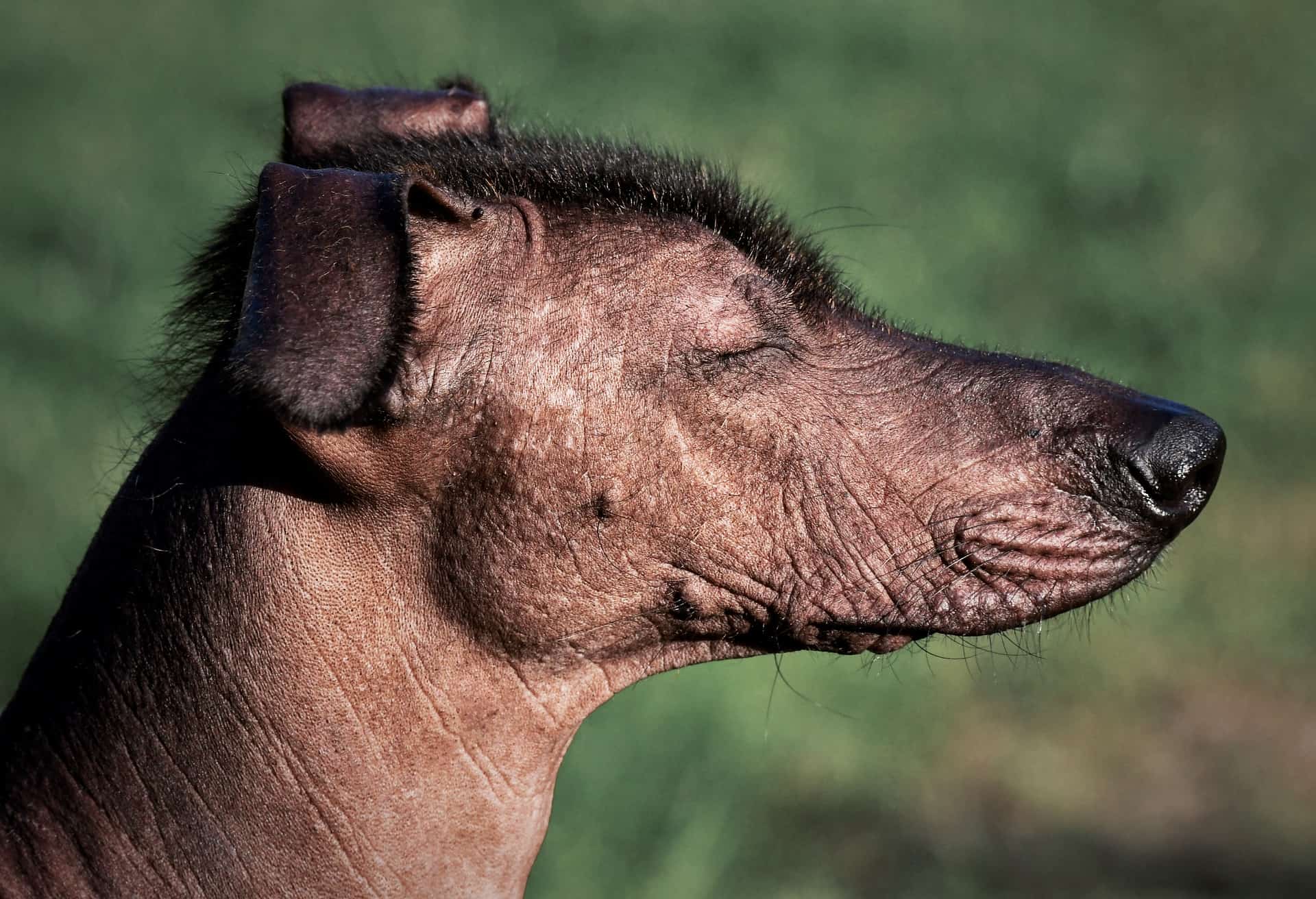
The hairless variety, which makes up roughly two thirds of Xolos, needs no brushing, but the exposed skin requires regular wiping or bathing to prevent acne and blackheads, particularly in young dogs. Light-skinned individuals may need sunscreen in strong sun. The skin itself is naturally thick and hide-like, far tougher than it looks. In cold weather, a hairless Xolo needs a sweater; with a cold_tolerance score at the floor, this is not optional. The coated third of the breed needs only occasional brushing.
Health
The Xolo is a hardy, long-lived primitive breed with few documented major health concerns. The gene responsible for hairlessness also causes some dental anomalies, so teeth are worth monitoring. Toy-size individuals occasionally show patellar luxation. Skin care in hairless dogs is the main ongoing management task. Life expectancy runs 11 to 14 years.
Why these breeds are similar
No similar breeds are listed in the source data for the Xoloitzcuintli. The breed occupies a genuinely unusual position: ancient primitive type, hairless, Mexican origin, and with a religious rather than working-dog function. The closest parallels elsewhere are other hairless breeds such as the Chinese Crested, which shares the same dominant hairlessness gene and a similar lean, fine-boned build, and the Peruvian Inca Orchid, another ancient South American hairless breed with comparable temperament and care needs.
Trait ratings
- Energy level
- 3/5
- Exercise requirements
- 4/5
- Playfulness
- 3/5
- Affection level
- 4/5
- Friendliness toward dogs
- 4/5
- Friendliness toward other pets
- 3/5
- Friendliness toward strangers
- 3/5
- Ease of training
- 3/5
- Watchdog ability
- 5/5
- Protection ability
- 4/5
- Grooming requirements
- 2/5
- Cold tolerance
- 1/5
- Heat tolerance
- 5/5
Breeds similar to Xoloitzcuintli
No similar breeds are mapped for Xoloitzcuintli yet - try browsing its FCI group or country of origin below.