Sussex Spaniel
From Great Britain
Purpose & Origin
The Sussex Spaniel comes from the county that gives it its name. The first significant kennel was established in Sussex, England, in 1795, and the breed was already well enough known by 1820 to be praised in the sporting press as capable working dogs. Their job was upland shooting: slow, methodical tracking through dense cover, flushing small game for the gun.
What set them apart from faster spaniels was an unusual habit of giving tongue on scent, essentially speaking aloud while working. That trait endeared them to hunters who wanted to follow their dog by ear through heavy cover, but it cost them badly when field trials began rewarding silent, swift hunters instead.
The Sussex was among the first ten breeds recognised by the AKC, yet popularity never followed. The twentieth century was nearly fatal for the breed, with numbers so low that deliberate inbreeding became unavoidable, and a Clumber Spaniel outcross was made in 1954 to widen the gene pool. The breed remains one of the rarest in the AKC registry.
Temperament & Behaviour
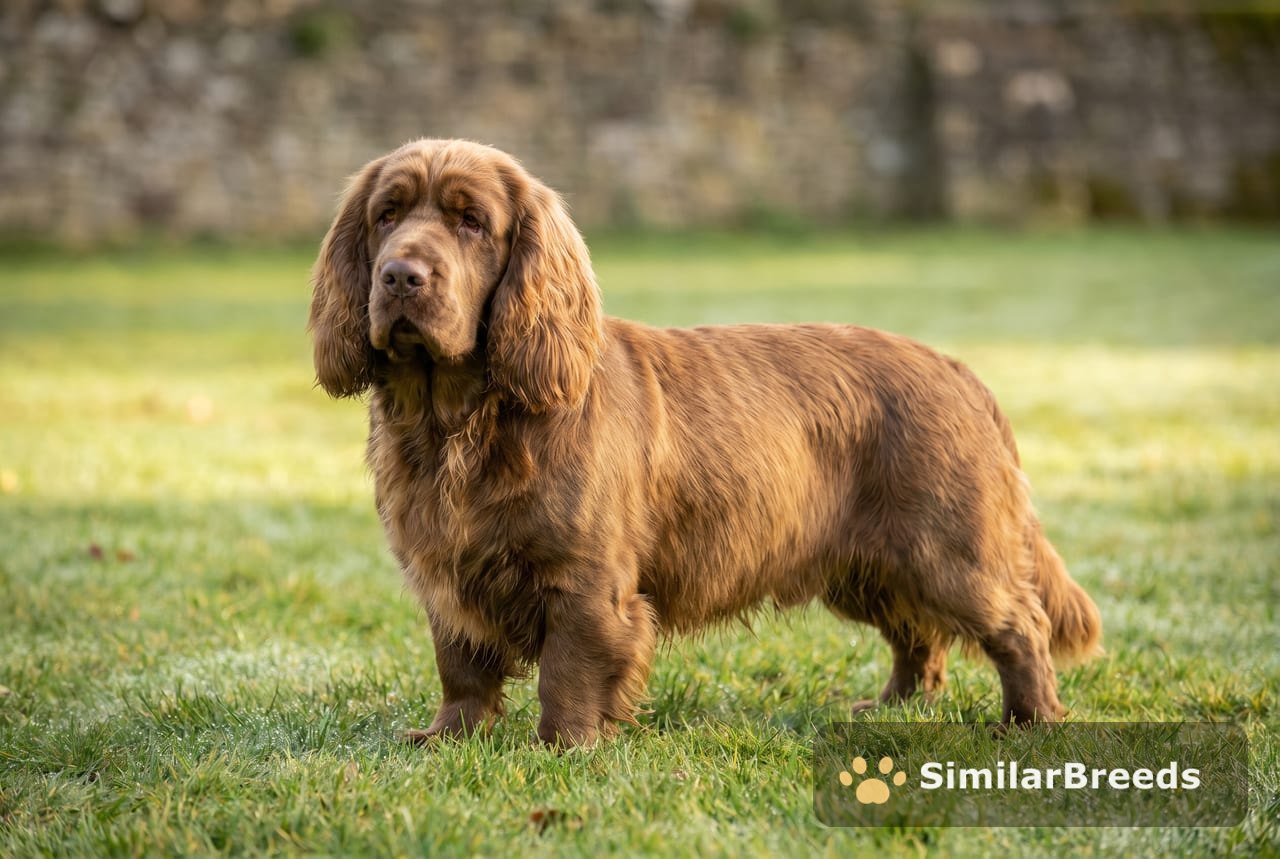
The Sussex is notably calmer than most spaniels, a trait that suits apartment or city living better than the breed's hunting heritage might suggest. At home it is steady and easygoing, with a serious, almost solemn facial expression that flatly misrepresents its actual cheerfulness. Affection toward its family is genuine and consistent.
The breed is reasonably sociable with other pets and comfortable enough with dogs, though it is not especially gregarious with strangers. Its watchdog instinct is solid: it will bark at what it considers worth reporting, and if left out while the household is busy, it may carry on vocalising. That tendency to give tongue is old and bred-in, not something training will fully eliminate.
Activity & Training
Daily exercise is necessary but not demanding. A proper walk on lead or a short free run in a yard satisfies the Sussex on most days; a longer outing in field or park is appreciated when available, but the breed does not require it to stay manageable indoors.
Training is a different matter. The ease-of-training score is low, and it shows: the Sussex can be stubborn and is not particularly motivated to please in the way a Labrador or Golden might be. It responds best to consistent, patient work with clear rewards, and poorly to repetitive drills or harsh handling. First-time owners who expect quick obedience are likely to find the breed frustrating.
Grooming
The coat is moderate in its demands. Brushing and combing two to three times a week keeps the flat, somewhat wavy outer coat free of tangles and the feathering on ears, legs, and chest tidy. The ears, which hang close to the head, need regular checking for moisture and debris, as the breed is noted for susceptibility to ear infections. No specialist trimming is typically required, but the coat should be kept clean, particularly around the feet and underside after field outings.
Health
The Sussex carries a few recurring concerns worth knowing before acquisition. Hip dysplasia and intervertebral disc disease are the primary issues, the latter linked to the breed's long, low build. Cardiac problems including heart murmurs and enlarged heart appear as minor concerns, and PDP1 (pyruvate dehydrogenase phosphatase deficiency) is occasionally seen. Prospective owners should ask breeders for hip and cardiac clearances. Lifespan runs 11 to 13 years. The breed's limited gene pool, a consequence of its near-extinction history, makes choosing a responsible breeder with health-tested stock more important than with more numerous breeds.
Why these breeds are similar
No similar breeds are currently listed in the source data for the Sussex Spaniel.
Trait ratings
- Energy level
- 3/5
- Exercise requirements
- 3/5
- Playfulness
- 3/5
- Affection level
- 4/5
- Friendliness toward dogs
- 3/5
- Friendliness toward other pets
- 4/5
- Friendliness toward strangers
- 3/5
- Ease of training
- 2/5
- Watchdog ability
- 4/5
- Protection ability
- 3/5
- Grooming requirements
- 3/5
- Cold tolerance
- 3/5
- Heat tolerance
- 3/5
Breeds similar to Sussex Spaniel
No similar breeds are mapped for Sussex Spaniel yet - try browsing its FCI group or country of origin below.