Chinook
From USA
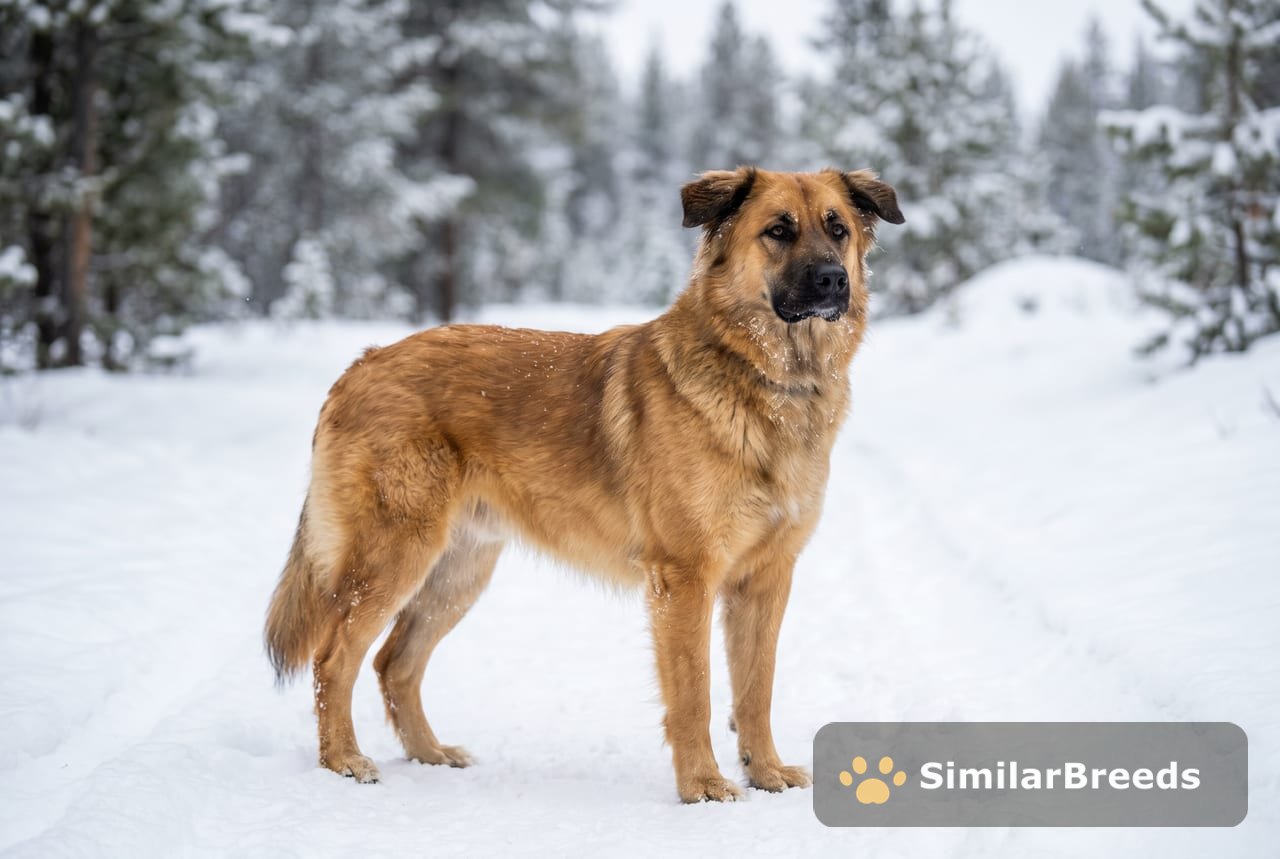
Purpose & Origin
The Chinook is one of the rarest working breeds in existence, and it owes its entire identity to a single dog. In 1917, a New Hampshire musher named Arthur Walden crossed a large tawny farm dog of mastiff type with a Greenland Husky named Polaris, a lead dog from Admiral Peary's Arctic expeditions. One of the resulting puppies became Walden's prized lead dog and gave the breed its name. Walden crossed the original Chinook with Belgian and German Shepherd working dogs and Canadian Eskimo Dogs to refine the line, producing a draft sled dog built for endurance rather than speed.
The breed's defining moment came in 1929, when an aging Chinook and fifteen of his descendants joined Admiral Byrd's Antarctic expedition. Byrd credited them as the backbone of the operation. The dog died on that ice, and the breed nearly followed: by 1981 only eleven breedable Chinooks existed. Several breeders mounted a recovery effort, and the Chinook entered the AKC Working Group in 2013, the same year New Hampshire made it the official state dog.
Temperament & Behaviour
The Chinook has a disposition that sets it apart from most sled dogs: it is calm, genuinely gentle, and strongly people-oriented. It bonds closely with its family and does well with children and other animals, including other dogs in most cases, though some males can be combative with rival males. Strangers tend to get a reserved reception, and some individuals lean toward shyness, so early socialisation matters. The breed is quiet by sled-dog standards and makes only a middling watchdog, with no real protective instinct. When excited, Chinooks are more likely to whine or vocalize softly than to bark.
Activity & Training
The Chinook's exercise needs are moderate for a working breed: a solid daily walk plus several off-lead runs through the week covers it. Cold is no problem given the breed's origins, but heat is genuinely taxing, so exercise timing matters in summer. Training is reasonably straightforward. The breed is biddable and cooperative, and unlike many Northern breeds it tends to be reliable off lead, which is unusual for dogs with a sledding heritage. It is not a natural retriever, so fetch-based games hold little appeal. It does much better living inside with its family than kennelled outdoors.
Grooming
The coat is a double one suited to harsh winters and needs weekly brushing under normal conditions. During shedding seasons, daily brushing becomes necessary, because shedding is heavy. Aside from that, the Chinook's grooming demands are unremarkable.
Health
The Chinook is a long-lived breed, with a typical lifespan of eleven to fourteen years. Minor concerns noted in the breed include seizures, hip dysplasia, and cryptorchidism in males. Cataracts have been seen occasionally. Hip and eye evaluations are the standard health screenings for the breed.
Why these breeds are similar
No similar breeds are currently listed for the Chinook in this database.
Trait ratings
- Energy level
- 3/5
- Exercise requirements
- 3/5
- Playfulness
- 3/5
- Affection level
- 4/5
- Friendliness toward dogs
- 4/5
- Friendliness toward other pets
- 4/5
- Friendliness toward strangers
- 2/5
- Ease of training
- 3/5
- Watchdog ability
- 3/5
- Protection ability
- 2/5
- Grooming requirements
- 3/5
- Cold tolerance
- 5/5
- Heat tolerance
- 2/5
Breeds similar to Chinook
No similar breeds are mapped for Chinook yet - try browsing its FCI group or country of origin below.